
Explore PLA+, PLA Matte, PLA Silk, and specialty PLA variants. Learn their unique properties and choose the right filament for your 3D printing project.
📋In This Post
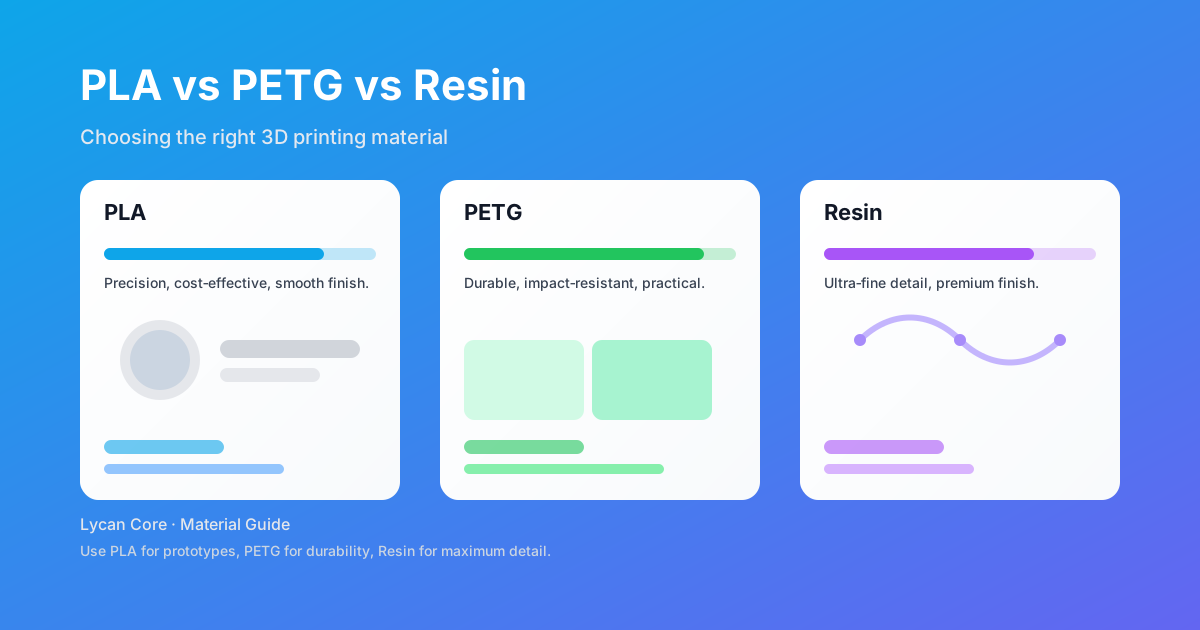
Polylactic acid (PLA) is the most popular 3D printing filament worldwide, but not all PLA is created equal. With variants like PLA+, PLA Matte, PLA Pro, PLA Silk, and more, choosing the right type can significantly impact your print quality and part performance.
This comprehensive guide explores the different PLA variants available and helps you select the best one for your specific application.
What is Standard PLA?
Standard PLA (Polylactic acid) is a biodegradable thermoplastic polyester derived from renewable resources like corn starch, sugarcane, or sugar beet [1]. It's the most beginner-friendly 3D printing material due to its low printing temperature (190-220°C), minimal warping, easy bed adhesion, good detail reproduction, and pleasant printing experience with low odor and non-toxic fumes.
Technical Specifications (Standard PLA)
| Property | Value | Unit |
|---|---|---|
| Density | 1.21-1.25 | g/cm³ |
| Tensile Strength | 48-60 | MPa |
| Elongation at Break | 5-7 | % |
| Glass Transition Temp | 56-58 | °C |
| Melting Temperature | 160-177 | °C |
| Printing Temperature | 190-220 | °C |
Data sourced from scientific literature on polylactic acid materials science [2].
Limitations of Standard PLA
While standard PLA is excellent for many applications, it has notable limitations: brittleness (low impact strength), heat sensitivity (deforms above 60°C), UV degradation, poor layer adhesion compared to other materials, and limited flexibility (only 5-7% elongation before breaking). These limitations led to the development of enhanced PLA variants.
PLA+ (PLA Plus / PLA Pro)
PLA+ (also called PLA Plus or PLA Pro) is an enhanced formulation of standard PLA with additives and modified polymer chains that improve mechanical properties without significantly changing print settings [3].
Key Improvements Over Standard PLA
- Increased Strength: Tensile strength up to 60-70 MPa (25% higher), 2-3x more impact resistant, better layer adhesion
- Enhanced Flexibility: Elongation at break 10-15% (double that of standard PLA), less brittle, better bend resistance
- Improved Print Quality: Smoother surface finish, reduced stringing, enhanced bed adhesion
Best Applications for PLA+
PLA+ is ideal for functional prototypes requiring moderate durability, mechanical parts with moving components, larger prints benefiting from improved layer adhesion, outdoor displays (short-term), replacement parts for household items, and toys and figurines that will be handled frequently.
Printing Tips for PLA+
- Print temperature: 205-220°C (slightly hotter than standard PLA)
- Bed temperature: 50-65°C (heated bed recommended)
- Print speed: 40-60 mm/s
- Cooling: 50-100% fan after first layer
- Retraction: 4-6mm at 40 mm/s (may need tuning)
PLA Matte (Matte Finish PLA)
PLA Matte is a specialized PLA formulation that produces prints with a non-glossy, textured surface finish. The matte effect is achieved through additives that scatter light, creating a sophisticated, professional appearance [4].
Unique Characteristics
PLA Matte offers no glossy reflection with an elegant, understated finish, reduced visibility of layer lines masked by texture, professional appearance suitable for display models, and a unique tactile feel with slightly rough texture.
Print Quality Advantages
- Hides minor defects through surface texture
- Better color depth (matte surfaces appear richer)
- Reduced fingerprint visibility
- Professional photography (no glare)
PLA Matte Best Uses
Perfect for display models and figurines requiring premium aesthetics, architectural models where glossy surfaces would be distracting, product mockups for photography and presentations, art projects where surface texture enhances design, signage and branding items with sophisticated appearance, and consumer products where touch-feel quality matters.
PLA Silk (Metallic PLA / Shiny PLA)
PLA Silk contains metallic or pearlescent additives that create a glossy, reflective surface finish reminiscent of silk fabric or metallic paint [5].
Distinctive Features
- High gloss finish with mirror-like reflection
- Metallic sheen with color-shifting appearance
- Luxury aesthetic for decorative items
- Wide color range: gold, silver, bronze, copper, colored metallics
Ideal Applications for PLA Silk
PLA Silk is excellent for decorative items like vases, ornaments, jewelry, cosplay props requiring metallic appearance, awards and trophies, luxury product prototypes, art installations where visual impact is paramount, and gift items benefiting from eye-catching finish.
Printing Recommendations for Silk PLA
- Nozzle size: 0.4mm minimum (larger reduces clog risk)
- Print temperature: 210-230°C (higher for smoother finish)
- Print speed: 30-40 mm/s (slower for best gloss)
- Cooling: 50-75% fan (less cooling enhances gloss)
- Maintenance: Clean nozzle regularly, consider hardened steel nozzle
Other PLA Variants
PLA Wood-Fill
Composition: PLA mixed with wood fibers (10-40% by volume)
Best for: Decorative items, architectural models, artistic projects
Natural wood-like appearance and texture, can be sanded and stained. Requires larger nozzle (0.5mm+) and regular cleaning.
PLA Metal-Fill
Composition: PLA with metal powder (copper, bronze, brass, steel)
Best for: Jewelry, medals, functional parts requiring weight, cosplay armor
Authentic metal weight and feel, can be polished to metallic shine. Requires hardened steel nozzle.
PLA Glow-in-the-Dark
Composition: PLA with phosphorescent pigments
Best for: Safety markers, toys, decorative items, novelty gifts
Glows after exposure to light, glow intensity fades over minutes. Use standard PLA settings.
High-Temperature PLA (HT-PLA)
Composition: Modified PLA with enhanced thermal stability
Best for: Parts exposed to heat, dishwasher-safe items, automotive applications
Heat deflection temperature: 90-110°C (vs 55-60°C standard). Requires annealing process post-printing (shrinks 2-4%).
Comparison Table: PLA Variants Side-by-Side
| Variant | Strength | Flexibility | Surface Finish | Best Use |
|---|---|---|---|---|
| Standard PLA | Moderate | Low | Semi-gloss | General prototypes, models |
| PLA+/Pro | High | Moderate | Smooth | Functional parts, durable items |
| PLA Matte | Moderate | Low | Matte/textured | Display models, photography |
| PLA Silk | Low-Moderate | Low | High gloss | Decorative, jewelry, awards |
| Wood-Fill | Low | Very Low | Rough/natural | Decorative art, naturalistic items |
| High-Temp PLA | Moderate | Low | Semi-gloss | Heat-exposed parts, dishwasher-safe |
How to Choose the Right PLA Variant
Decision Framework
- For Mechanical Strength → Choose PLA+ / PLA Pro (parts under stress, frequent handling)
- For Aesthetics & Display → Choose PLA Matte (professional elegance) or Silk (eye-catching luxury)
- For Artistic Expression → Choose Specialty Fills (Wood-fill for natural look, Metal-fill for authentic metal appearance)
- For Functional Heat Exposure → Choose High-Temp PLA (dishwasher-safe items, automotive parts)
- For Beginners → Choose Standard PLA or PLA+ (most forgiving, widely available, affordable)
Environmental Considerations
While PLA is marketed as "biodegradable," it's important to understand the reality [6]:
Industrial Composting Only: PLA requires temperatures above 60°C for significant degradation. Home composting is insufficient (too cool, breaks down very slowly). Landfill conditions: PLA persists for decades like conventional plastics.
Ocean Degradation: Research shows PLA degrades no faster than PET in seawater environments [7]. After 200+ days in marine conditions, PLA shows minimal decomposition.
Recommendation: Choose PLA for its performance and printability, not solely for environmental reasons. Practice responsible disposal through specialized recycling programs when available.
Cost Comparison
| Material | Price Range (ZAR) | Price Range (USD) |
|---|---|---|
| Standard PLA | R250-R400 | $15-$25 |
| PLA+ / PLA Pro | R350-R500 | $20-$30 |
| PLA Matte | R400-R550 | $23-$33 |
| PLA Silk | R400-R600 | $23-$35 |
Prices vary by brand, color, and supplier. Premium brands command higher prices.
Conclusion: Choosing Your PLA Variant
The world of PLA filaments offers incredible variety for different applications:
- Learning 3D printing? → Start with standard PLA
- Need stronger parts? → Upgrade to PLA+
- Want professional display quality? → Choose PLA Matte
- Creating decorative items? → Select PLA Silk
- Artistic projects with texture? → Try specialty fills
- Heat-resistant applications? → Use High-Temp PLA
At Lycan Core
We offer professional 3D printing services with premium PLA filaments including standard PLA printing (R399/kg), PLA+ for enhanced durability, and specialty finishes (Matte, Silk) available on request. Our experts provide guidance on material selection for your project.
Ready to bring your ideas to life? Request a quote or browse our 3D printing services.
References
- Auras, R., Lim, L. T., Selke, S. E., & Tsuji, H. (Eds.). (2010). Poly(Lactic Acid): Synthesis, Structures, Properties, Processing, and Applications. John Wiley & Sons. https://doi.org/10.1002/9780470649848
- Ashby, M. F. (2013). "Polylactide (PLA) - Material Properties." In Materials and the Environment (2nd ed., pp. 27-41). Elsevier. https://doi.org/10.1016/B978-0-12-385971-6.00015-4
- Nagarajan, V., Mohanty, A. K., & Misra, M. (2016). "Perspective on Polylactic Acid (PLA) based Sustainable Materials for Durable Applications: Focus on Toughness and Heat Resistance." ACS Sustainable Chemistry & Engineering, 4(6), 2899-2916. https://doi.org/10.1021/acssuschemeng.6b00321
- Martin, O., & Avérous, L. (2001). "Poly(lactic acid): plasticization and properties of biodegradable multiphase systems." Polymer, 42(14), 6209-6219. https://doi.org/10.1016/S0032-3861(01)00086-6
- Simmons, H., Tiwary, P., Colwell, J. E., & Kontopoulou, M. (2019). "Improvements in the crystallinity and mechanical properties of PLA by nucleation and annealing." Polymer Degradation and Stability, 166, 248-257. https://doi.org/10.1016/j.polymdegradstab.2019.06.001
- Castro-Aguirre, E., Iñiguez-Franco, F., Samsudin, H., Fang, X., & Auras, R. (2016). "Poly(lactic acid)—Mass production, processing, industrial applications, and end of life." Advanced Drug Delivery Reviews, 107, 333-366. https://doi.org/10.1016/j.addr.2016.03.010
- Royer, S. J., Greco, F., Kogler, M., & Deheyn, D. D. (2023). "Not so biodegradable: Polylactic acid and cellulose/plastic blend textiles lack fast biodegradation in marine waters." PLOS ONE, 18(5), e0284681. https://doi.org/10.1371/journal.pone.0284681
✓Key Takeaways
- •Fast turnaround: Most projects completed within 3-7 business days
- •Competitive pricing starting from R250 per project
- •Multiple materials: PLA, PETG, and Resin for different applications
- •Expert design consultation included with every project
📐Custom Design
🧮Price Calculator
About Lycan Core
Lycan Core is South Africa's leading provider of professional 3D printing and custom fabrication services. Since 2025, we've been helping startups, engineers, and businesses bring their ideas to life with cutting-edge technology and expert craftsmanship.
Learn more about Lycan Core →